
To listen to today’s reflection as a podcast, click here
In an episode of the TV series Boston Legal, Tom Selleck’s fiancé struggles with fits of uncontrolled laughter.
The only way to break the spell is to remind her of a tragedy. Selleck speaks just two words: “Bill Buckner.” She immediately stops laughing.
Why does that name, in the minds of all Bostonians, represent tragedy?
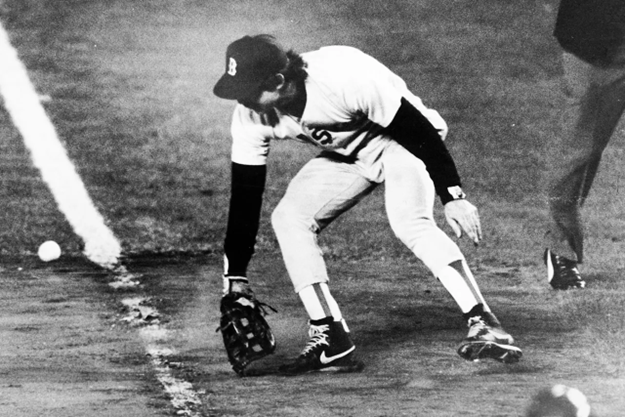
Bill Buckner was playing first base for the Red Sox on October 25, 1986, in the sixth game of the World Series against the New York Mets. The game was tied in the 10th inning. There were two outs. The Mets had the potential winning run standing on second base.
Mookie Wilson hit a slow roller toward first. Buckner hustled toward it, knowing that Mookie was a speedster. All he had to do was field the ball, step on first, and send the game into the 11th inning.
The ball bounced once. Then twice. Buckner reached out to snag it on the third bounce. But that bounce never came. As he later said, “It scooted.” Right between his legs into right field.
Ray Knight of the Mets scored from second base. The Mets not only won that game, but went on to win game seven and thus the Series. “The Curse,” which fans of the Red Sox believed had deprived them of championships for almost the entirety of the 20th century, now had a new focus. His name was Bill Buckner, and he was immediately assailed by hatred, mockery, and death threats.
The Leonard P. Zakim Bunker Hill Memorial Bridge in Boston was quickly nicknamed the Bill Buckner Bridge. Why? Because the traffic goes between the “legs” of the bridge.
The rancor was absurd. Even if Buckner had made that play, the Sox would still have had to win the game. And they obviously had plenty of chances to prevail in game seven the following day.
But that single fielding error somehow became the most infamous personal failure in sports history.
The irony is that Bill Buckner was one of the finest baseball players of his generation. He won a battling title and hit over .300 seven times. During three of his seasons he batted in more than 100 runs. He never struck out more than 39 times in any of his 22 years in the league. Most notably, he was an exceptional defensive player, setting an MLB record for the most assists by a first baseman – the same season he led the National League in doubles. To this day he holds the American League record for most assists in a season.
He was also plagued by ankle injuries during most of his career. One of the reasons he rushed toward Mookie Wilson’s slow roller that October evening is that he wanted to muster enough speed to beat him to the bag.
Through all the public vitriol, Buckner retained a gracious spirit.
On April 8, 2008, the Red Sox invited their long-retired first baseman to throw out the first pitch at their season home opener – the day they unfurled their 2007 World Series championship banner. The sellout crowd sprang to their feet. They applauded Bill Buckner for two minutes.
A few years later, he appeared in an episode of the TV comedy series Curb Your Enthusiasm. A terrified mother throws her baby from a window of a burning building. The baby ricochets off the tarp held by firefighters, sails farther down the street, only to be heroically caught by a diving Buckner.
The first baseman, who died of a rare disease in 2019, clearly retained his sense of humor. He did not go to his grave a bitter man.
Nor did Fred Snodgrass, who was one of the finest center fielders in the National League in 1912, when his New York Giants went to the World Series. Unfortunately, on a beautiful October afternoon, he dropped a lazy fly ball in the 10th inning which allowed…wait for it…the Boston Red Sox to win the Series.
Snodgrass became the scapegoat. When he died in 1974, the New York Times headline blared, “Fred Snodgrass, 86, Dead; Muffed 1912 Fly Ball.”
Really?
Was that really the defining headline of Snodgrass’ life a whopping 62 years after he had made a single glaring fielding error?
Following his baseball career, Snodgrass moved to the West coast and became a successful banker and rancher. He was a popular city councilman in Oxnard, California, and ultimately was elected mayor. He and his wife became the parents of two daughters, Eleanor and Elizabeth. Likewise, Bill Buckner and his wife Jody were blessed with two daughters, Brittany and Christen, and a son, Bobby.
By any stretch of the imagination, it seems as if these two baseball pariahs were able to lead rich and meaningful lives.
But as Maxie Dunham observes, “Our society is so success-oriented that to fail makes you feel like a failure, and to lose makes you a loser.”
Fred Snodgrass’s life didn’t end, however, in center field in the 10th inning of a World Series game. And Bill Buckner’s existence didn’t become meaningless when he muffed that grounder behind first base during another infamous World Series 10th inning.
Snodgrass once said, “A lot of people have come up to me and said, ‘You really helped me in my life… I looked at what you had to go through, and how you handled it, and my life is better because of that.”‘
Where do we find the resolve to keep going, even in the face of failure?
The psalmist says concerning the Lord, “He drew me up from the pit of destruction, out of the miry bog, and set my feet upon a rock, making my steps secure. He put a new song in my mouth, a song of praise to our God. Many will see and fear, and put their trust in the Lord” (Psalm 40:2-3).
Because of God’s amazing grace, our worst days don’t have to become our legacies.
Failure isn’t final.
Unless, of course, we fail to receive what God alone can provide – his freely offered gift of second chances.